

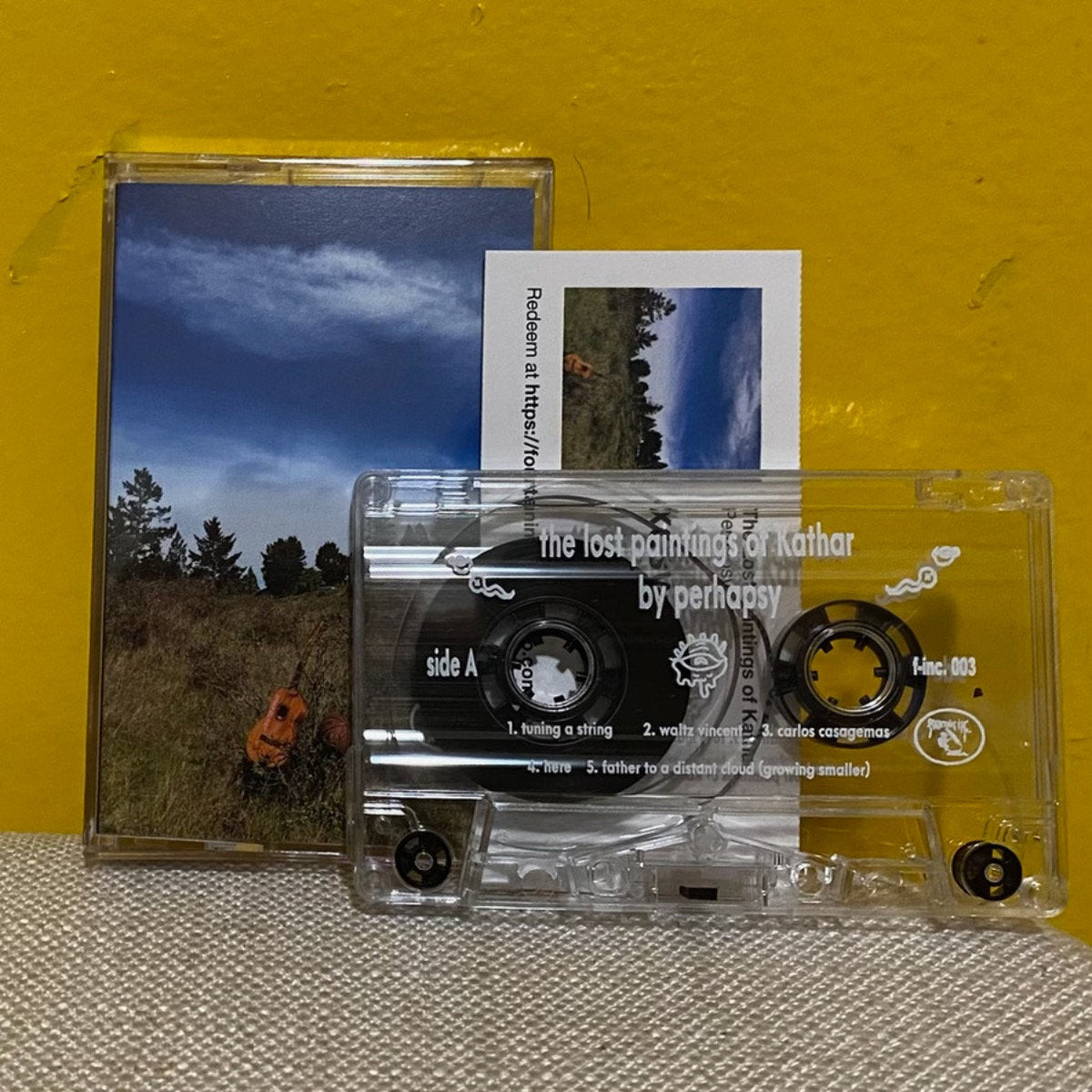
Perhapsy "The Lost Paintings of Kathar" Cassette
Perhapsy "The Lost Paintings of Kathar" Cassette
Couldn't load pickup availability
In stock now!
The Lost Paintings of Kathar, Derek Barber’s latest full length album as Perhapsy, is an emotionally complex, melancholy, strangely hopeful, and densely-layered expansion on many of the lyrical themes and musical styles that Barber has been exploring in Perhapsy albums for the past decade.
The guiding lyrical theme of the album is the creative act itself. Barber—who is a talented visual artist in addition to a musician—references painters throughout these ten songs, from the famous (van Gogh in “Waltz Vincent”) to the obscure (“Carlos Casagemas”, whose suicide at age 20 is said to have inspired his friend Pablo Picasso’s Blue Period), from the personal (Barber’s own departed father, one of the subjects of “Here”, was a talented watercolorist) to the mysterious (the titular Kathar, see below).
I couldn’t find any trace online or in my art history books of the painter whose name gives the album its title. I asked Barber for more information and he sent along this short explanation:
Batsa Kathar (1849-1893) was an obscure Nepalese painter of the same time period as the Post-Impressionists. Very little of his work was known until the early 1980s when his unmarked burial site was discovered near Belauri. Nearly 80 previously unknown paintings finally saw the light of day — because he was generally unappreciated in his own time, it was rumored he requested to be buried with his artwork in an unmarked grave out of spite. The 1983 discovery confirmed such rumors. He’s been a very big influence on my own artwork and the music from several bands, including the Dublin 80s goth-pop group simply known as KATHAR. This album is dedicated to the great painter and his life’s work.
It is notable that none of these painters found fame in their own lifetimes (if at all). Van Gogh sold only two paintings in his lifetime. Casagemas is better known as a subject of his more famous friend’s paintings than for his own fascinating artistic output. Kathar was buried with his own artwork and remains so obscure as to become little more than a folktale.
There is a darkness in the stories of each of these artists and in this album, as well. Van Gogh and Casagemas died at their own hands. Barber’s father passed away more than 20 years ago. Album closer “Mill Valley” is about a fire that consumed Barber’s grandmother’s home in Mill Valley shortly after she died. And Kathar took his art to his grave, literally.
Consider the questions posed at the beginning of the title track: “What happens when the will of the artist wanes away? / How many hues of auburn and the hours of the flowers remain?”
The spitefulness of Kathar, the mad ecstasy of van Gogh, the frustration of Casagemas (who killed himself in part because of his sexual impotence preventing him from consummating a love affair) serve as a questioning of art’s ability to serve as a savior. Indeed, that darkness is present throughout, in songs such as “Ballad On a Basketball,” lamenting the futility of finding understanding through creative expression:
It's hard to play a ballad on a basketball
It’s hard to know the things you truly love at all
And when you get the truth, hope you figure it out
And when you get the truth, hope you figure me out
But there are still slivers of light amongst the gloom. “Tuning A String” and “Rose Marie” both attest to the beauty of singing a song. And the evident care put into the music itself, combined with Barber’s soft, sweet vocals, serves as a counterweight to the dark night of the soul traversed by several of the songs.
Viewed as a whole, a thesis emerges: the creative act is something that finds fulfillment in its own expression, rather than as a means for worldly enrichment or even emotional catharsis. Indeed, there are hints at the joy of art and true sense of sympathy toward artists. In “Waltz Vincent”, Barber sings: ““And so you’ll see / A reflection of me / Someday in the way / He tried”. And the final lines of the album, after his grandmother’s home has burned to the ground, are a simple refrain of mercy:
We were saved
We were safe
We were saved
We were safe
Musically, Barber refines a number of techniques and stylistic markers that he has explored on previous albums: watery, gauzy textures influenced by post-rock; samples of movie dialogue and snatches of studio conversation and field recordings reminiscent of 1990s emo and indie rock; hushed vocal melodies; layered guitar arpeggios; chord progressions that are 90% within the realm of folk and alternative rock with just a touch of jazz-influenced voicing and occasional, unexpected modulation; and a restrained sort of guitar virtuosity. Indeed, this last element is probably the defining musical element of all Perhapsy recordings and is in fine form here.
Barber’s prodigious abilities as a guitarist are a key element of his day jobs as a music educator, studio musician, and touring guitarist. Often with guitarists of Barber’s caliber, their solo music is basically a showcase of their ability to shred. Barber doesn’t follow this path, instead using his guitar abilities tastefully to support his talents as a songwriter. Which isn’t to say that he shies away from his guitar virtuosity but rather that he displays it in a way that doesn’t overwhelm the other elements of these songs.
For example, listen to the brief, soaring solo toward the end of “Waltz Vincent”. But just as often, he’ll make use of alternate tunings and fingerpicking to create a bed of guitar textures to support his sweet singing voice. To make a mishmash of comparisons, imagine Murray Street-era Sonic Youth covering a Judee Sill song with Elliott Smith-style vocals and Grouper-style production.
Barber’s singing on this album is the strongest that he’s displayed on any Perhapsy recordings to date. While his vocals remain soft, he sings with the sort of confidence that makes that softness an asset rather than a detriment. Indeed, the lyrics to album opener and lead single “Tuning A String” serve well to explain his vocal approach:
Sometimes
I’ll think of that song
“Over the Rainbow”
And I sing along
My voice will dip
In and out of pitch
But its sacred melody
Won’t quit
Finding a voice
Tuning a string
Seems the same to me
The same thing
Sing on, Judy
Sing real clear
For all the sinners here
Voices no one will hear
Derek has been a friend of mine for many years and I’ve often worked with him on music and other creative projects. One of his defining characteristics as an artist is his willingness to follow his muse. Indeed, I’ve seen him grab a sharpie and start drawing on an empty pizza box with no preconceived plan only to result in a beautiful, grotesque drawing of winged, dripping creature that is equal parts celestial and weird.
Whether intentional or not, The Lost Paintings of Kathar serves as a powerful thesis of this approach to art and music. Sometimes a true artist such as Derek Barber has something inside him that he needs to express and bring into the world. And the value of that expression is best measured in its authenticity and its beauty on its own terms.
This is Barber’s best Perhapsy album yet and, not coincidentally, his truest expression of that creative drive that he carries within himself and brings to his art.
Chris Alarie (Bad Year No Mercy, In Watermelon Sugar, Chris Alarie)
Shipping, Local Pick Up, Returns & Cancellations Policies.
Shipping, Local Pick Up, Returns & Cancellations Policies.
SHIPPING:
We ship Monday through Friday. Orders typically ship within 24-72 hours. Tracking is sent to the email you provide at check out and may take a few days to become active.
Any items ordered with Pre-Orders will be held until they can all ship together. If you need in stock items faster please order them seperately.
LOCAL PICK UP POLICY:
Due to a large amount of unclaimed local pick ups over the years we have updated our policy. Any orders that remain unclaimed after 90 days from the initial "ready for pick up" notification will be considered abandoned and returned to our system without refund. If you are having issues picking up your order within this time frame please contact us via orders@1234gorecords.com. If you need your order shipped we can easily do so for an added shipping fee.
RETURNS:
Returns are only accepted on damaged or defective items. Return requests must be made within 7 days of delivery. Please save the original packaging.
If you own a Crosley, Victrola or any other lower end turntable that has no ability to adjust the weight of the tone arm and are experiencing skipping on a new record please try the "Penny Trick". Simply place a penny on the top of the cartidge and it should provide enough weight to resolve your issues. While a great entry to the world of vinyl we do recommend upgrading to a turntable with a tone arm that can be adjusted as this issue will randomly occur. We do not take returns in these cases.
Resellers: If you are buying from us for resale we honestly don't mind. However, please don't panic if something you bought suddenly isn't flipable for more money and then try to return stuff to us because you feel like you made a bad investment choice. Despite our outsized reputation we're a small shop, not amazon. Absorbing these costs adds up on places like ours. Plus a little patience always tends to pay off.
CANCELLATIONS:
Due to an increasing number of payment processors no longer returning transaction fees to sellers on cancelled orders and rising labor costs any orders or pre-orders that need to be cancelled before shipment will be assessed a 5% cancellation/restocking fee on the order total including shipping and any other taxes or fees associated with the order.
Thank you for your understanding.
Share
-
All Domestic orders over $75 ship for free!
Free shipping threshold does not include sales tax.