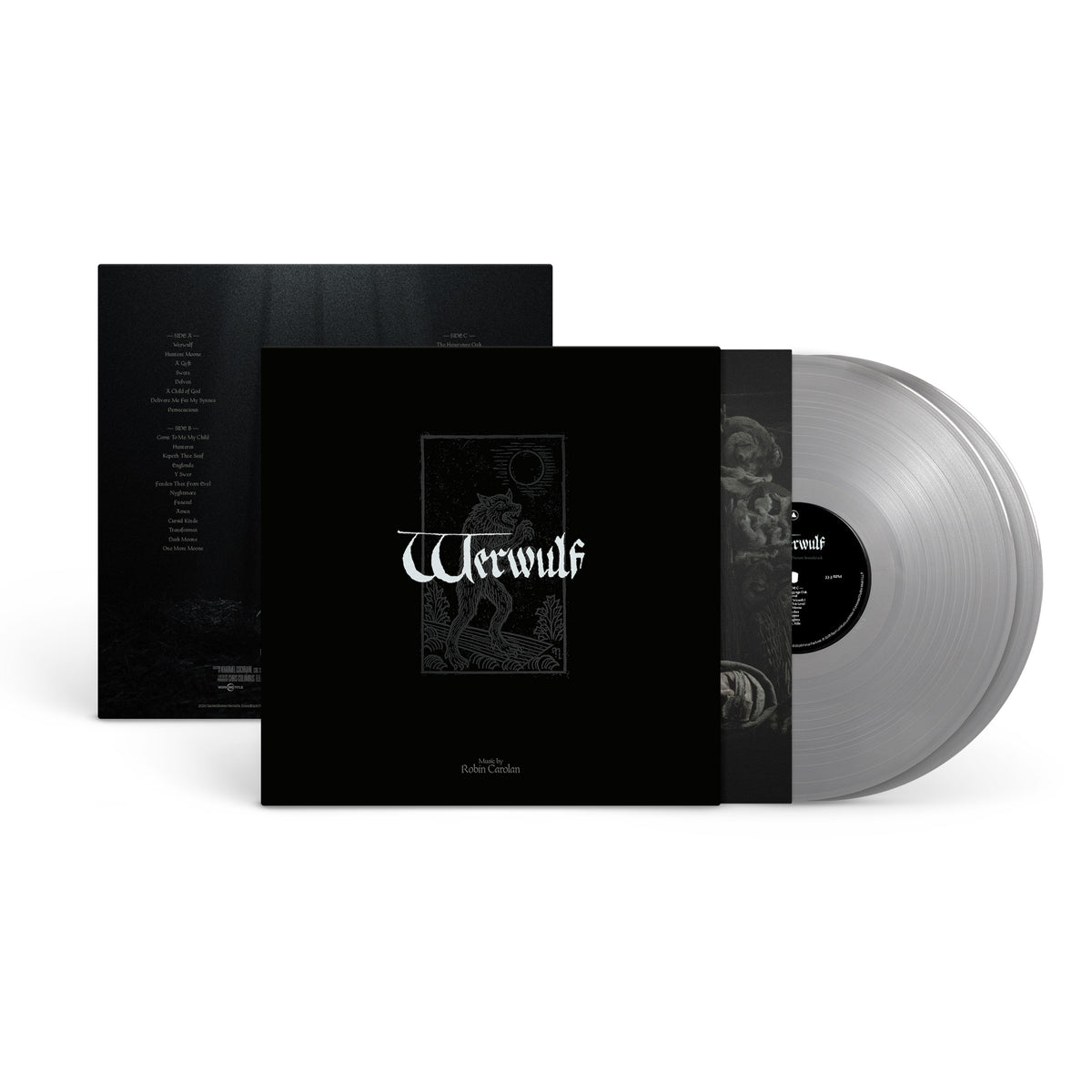
For his latest collaboration with Robert Eggers, Robin Carolan plunges
into the brutal, superstitious world of medieval England with Werwulf.
Drawing on the sounds, rituals and beliefs of the period, Carolan creates
a score that is at once gritty and folksy, surreal and otherworldly.
Hurdy-gurdies, the cymbalum and other archaic instruments are reimagined through unconventional playing techniques and electronic
manipulation. Everyday farming tools, including axes, cleavers and
scythes, were played against wood and bone to create uncanny percussive sounds, while bells and clay jugs became the source of strange drones. Together these sounds evoke the agricultural rhythms of the time while conjuring the unseen forces that shaped its beliefs.
Strings are central to the score’s unsettling atmosphere, shifting between
wind and creaking trees. Carolan experimented with a string quintet in
a session he called the “Ghost Meditations,” electronically manipulating
the recordings until they took on a spectral quality. He also drew on
experimental instrument makers Fron Reilly and Bart Hopkin, whose
adaptations of archaic instruments offered new ways to reimagine period sounds. Among the score’s collaborators are violinist Daniel Pioro,
who helped with the more experimental ideas for strings, string player
Laura Cannell with her extensive knowledge of medieval music, long-
time friend Jack Bevan, from the band Foals, who contributed folk per-
cussion, and Antonina Nowacka, whose voice brings a celestial quality
to the instrumentals.
The soundtrack also features “Wynter Waxeth,” an original song performed by Ethel Cain in Middle English. What began as a discussion
about using her voice as a texture within the score soon developed into
a fully fleshed out song. Medieval music, prayers and strange ambient
recordings were exchanged and with Eggers’ help, Cain mastered the
Middle English pronunciation, bringing an earthy, feral, haunted beauty to the score.
Carolan’s inspirations extended beyond music into art, literature and
the physical spaces of medieval England. The Drolatic Dreams of Pan-
tagruel, Lucas Cranach’s The Werewolf or the Cannibal, and English Me-
dieval Graffiti informed his thinking, while medieval churches offered a
chance to absorb their atmosphere first hand. Another important influ-
ence was Tōru Takemitsu’s score for Onimaru, an obscure 1980s Japanese adaptation of Wuthering Heights.
Werwulf is an exercise in world building, capturing not only the environ-
ment of the period but also the psychology of a society shaped by super-
stition, faith and the unknown. Designed to unnerve and disorient, the
score reaches for something emotionally overwhelming, reflecting what
Carolan sees as one of Eggers’ most devastating works.